À propos...
FAÇADE
« La façade n’est pas seulement une surface, elle est un vêtement, un masque qui à la fois cache et révèle » Jean Baudrillard
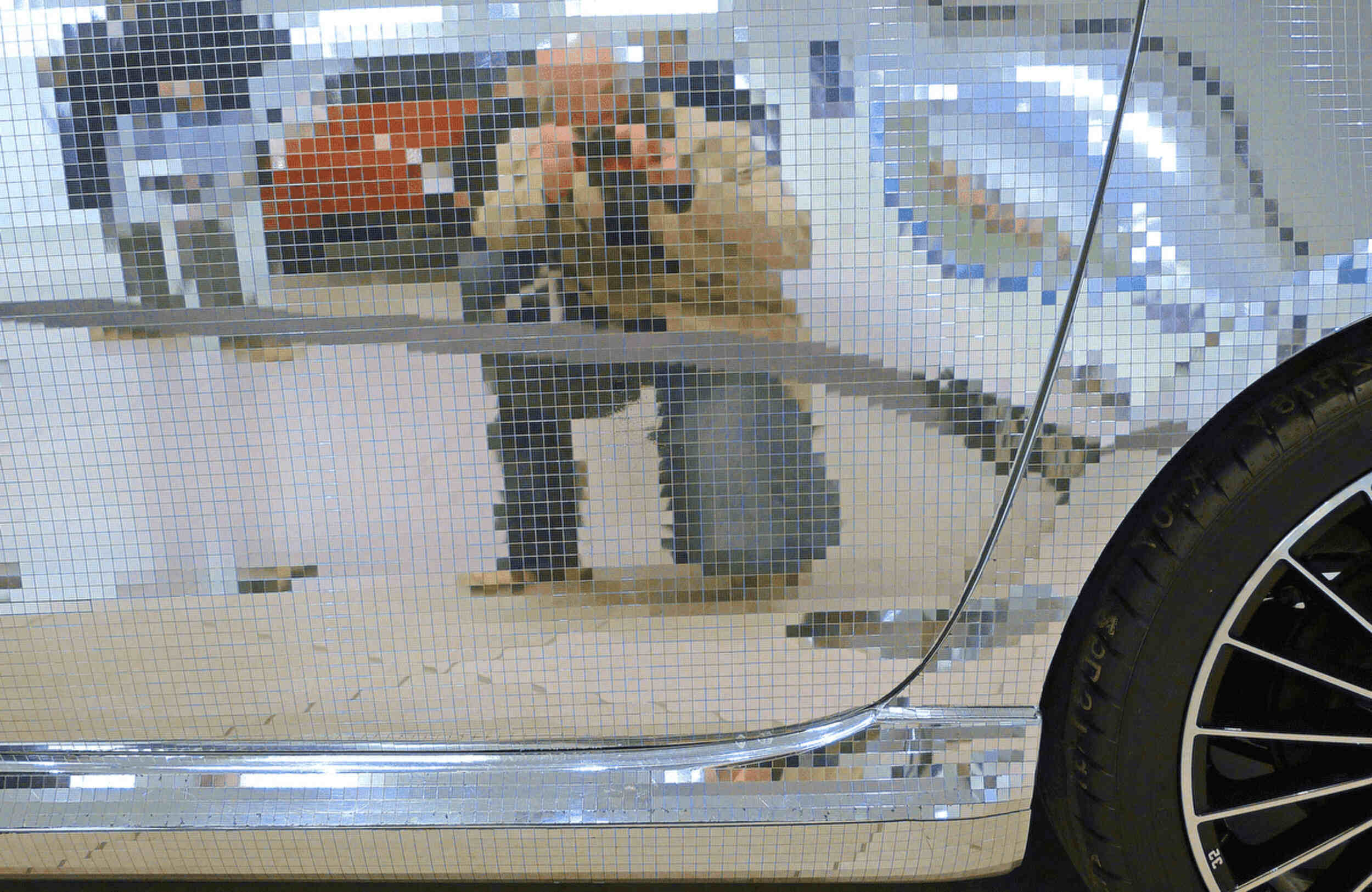
La façade, au-delà de sa définition architecturale, est un concept qui interroge la nature même de la surface, de la limite, de la représentation et de la médiation sociale. Elle est à la fois une frontière physique, une interface symbolique, un support de communication et un objet visuel ancré dans son environnement. Cette complexité invite à une approche qui dépasse la simple matérialité pour envisager la façade comme un objet théorique mouvant, un lieu de tension entre le visible et le caché, le réel et le représenté, l’exposé et le perçu.
Dans cette approche particulière du paysage urbain, j’ai d’abord voulu appréhender la façade comme une structure instable, dont la limite se déplace pour se réinscrire dans un environnement indissociable et vivant (mobilier urbain, végétation, ombres…) et devenir ainsi l’expression d’un nouveau langage esthétique comportant mes propres choix formels et stylistiques, un objet photographique.
J’ai réinterprété ce qui s’impose frontalement au regard en lui faisant obstacle comme une métaphore de la façade. En combinant des éléments contingents, éphémères ou fluctuants, j’ai organisé une surface formelle qui « fait façade » sans nécessairement introduire dans l’image d’éléments architecturaux.
Dans cette série, la notion de façade est abordée comme objet symbolique du cadrage photographique : d’une part en tant qu’espace de production de sens et de représentation de ce qui est donné à voir, d’autre part comme lieu de tension entre le fond et la forme.
FAÇADE
« The façade is not merely a surface; it is a garment, a mask that both conceals and reveals. » Jean Baudrillard
Beyond its architectural definition, the façade is a concept that interrogates the very nature of surface, boundary, representation, and social mediation. It is simultaneously a physical frontier, a symbolic interface, a medium of communication, and a visual object rooted in its environment. This complexity calls for an approach that transcends mere materiality, inviting us to consider the façade as a shifting theoretical object—a site of tension between the visible and the hidden, the real and the represented, the exposed and the perceived.
In this particular approach to the urban landscape, I first sought to grasp the façade as an unstable structure, whose boundary shifts to re-inscribe itself within an inseparable and living environment (street furniture, vegetation, shadows…) and thus become the expression of a new aesthetic language, shaped by my own formal and stylistic choices—a photographic object.
I reinterpreted what is frontally imposed on the gaze by obstructing it as a metaphor for the façade. By combining contingent, ephemeral, or fluctuating elements, I constructed a formal surface that « acts as a façade » without necessarily introducing architectural elements into the image.
In this series, the notion of the façade is approached as a symbolic object of photographic framing: on the one hand, as a space for the production of meaning and the representation of what is given to be seen; on the other, as a place of tension between content and form.
LAND ART
« Le land art nous rappelle que l’art n’est pas seulement une question d’objets, mais d’expériences, de perceptions, et de relations au monde. » Gilles Tiberghien
En faisant du paysage lui-même le support et le sujet de l’œuvre, Le Land Art place le spectateur au centre du projet artistique et pose des questions fondamentales sur la perception, la mémoire et la trace : il propose d’envisager l’art comme expérience vécue, et ouvre une réflexion plus large et subjective sur la relation entre l’œuvre, le paysage, le temps et l’humain.
Cette approche brouille les frontières entre l’art et la nature, et interroge leur capacité à dialoguer sous le regard du spectateur —sinon celui du photographe. La fragilité de l’œuvre et son statut éphémère, instable ou mouvant constituent une dimension centrale, suscitant une expérience immersive sensible mais provisoire.
Le land art redéfinit ainsi radicalement l’œuvre d’art comme événement artistique à la fois poétique et fugace, et invite à reconsidérer notre manière de percevoir l’art en général et la nature en particulier.
Mais les œuvres associées au land art revêtent des formes très diverses et les artistes ne revendiquent pas nécessairement leur appartenance à ce mouvement.
Je me suis inspiré de ces réflexions et de l’ambivalence entre nature et artifice propre à cet art pour produire des photographies où les éléments du réel s’agencent spontanément et de manière provisoire dans le paysage dans une évocation artistique similaire au land art.
Dans une première série, il s’agit d’éléments fugaces momentanément présents dans le paysage et qui s’organisent de manière à produire une image photographique. Dans une seconde série, il s’agit d’éléments installés durablement dans un paysage mouvant.
LAND ART
“Land art reminds us that art is not just a matter of objects, but of experiences, perceptions, and relationships with the world.” Gilles Tiberghien
By making the landscape itself the medium and subject of the work, Land Art places the viewer at the heart of the artistic project, raising fundamental questions about perception, memory, and traces: It encourages us to view art as a lived experience and fosters a deeper, more subjective reflection on the relationship between the artwork, the landscape, time and humanity.
This approach blurs the boundaries between art and nature, and questions their ability to engage in a dialogue under the gaze of the viewer—or even the photographer. The fragility of the work along with its ephemeral, unstable, or shifting nature constitute a central dimension, giving rise to a sensitive yet temporary immersive experience.
Land art thus radically redefines the work of art as an artistic event that is both poetic and fleeting, and invites us to reconsider the way we perceive art in general and nature in particular.
However, the works associated with land art take on very diverse forms, and the artists do not necessarily claim to belong to this movement.
I drew inspiration from these reflections and the ambivalence between nature and artifice inherent in this art form to produce photographs where elements of reality spontaneously and temporarily come together in the landscape, evoking an artistic expression akin to land art.
In the first series, these are fleeting elements momentarily present in the landscape which are arranged in such a way as to produce a photographic image. In a second series, these are elements that are permanently installed in an evolving landscape.
LITTORAL
Le paradoxe du littoral fractal révèle une propriété troublante des côtes naturelles : leur longueur n’est pas définie, elle se dérobe à toute mesure absolue. Plus l’unité de mesure est précise, plus la côte s’étire, potentiellement à l’infini. Ce phénomène découle de la nature fractale des littoraux, à la fois irréguliers et auto-similaires, et donc insaisissables.
Comment mesurer ce qui, par essence, échappe à la mesure ?
En cela, le paradoxe du littoral incarne une métaphore de notre difficulté à saisir le réel, et interroge nos outils de représentation. Il suggère que la réalité, dans sa complexité organique, résiste à l’inventaire, à la cartographie.
Ainsi Le littoral fractal n’est pas seulement une ligne de partage entre terre et mer, c’est un reflet de notre quête de certitude, partagée entre l’ambition de tout définir et la conscience de la vanité de ce désir. C’est une invitation à accepter l’indéterminé, le mouvant, à embrasser l’idée que la précision nous éloigne nécessairement de la vérité et que représenter, c’est admettre de ne jamais tout saisir.
COASTLINE
The fractal coastline paradox reveals a troubling property of natural coasts: their length is undefined, defying any absolute measurement. The more precise the unit of measurement, the more the coastline stretches, potentially to infinity. This phenomenon arises from the fractal nature of coastlines, which are irregular, self-similar, and thus elusive.
How can we measure what, by its very nature, escapes measurement?
In this, the coastline paradox embodies a metaphor for our struggle to grasp reality and challenges our tools of representation. It suggests that reality, in its organic complexity, resists both inventory and cartography.
The fractal coastline, then, is more than a boundary between land and sea; it mirrors our quest for certainty, torn between the ambition to define everything and the awareness of the futility of that desire. It is an invitation to embrace the indeterminate and the shifting, to accept that precision distances us from truth—and that to represent is to acknowledge we will never fully grasp it all.
PAYSAGES URBAINS CORÉENS
À l’image de sa topographie, la Corée est un pays contrasté. Pour le photographe, il est malaisé au premier abord de trouver une unité urbaine tant les extrêmes se côtoient en permanence dans les villes où modernité et tradition coexistent et où cette dualité est enchevêtrée.
Pour aborder le paysage urbain, il faut d’abord accepter de composer avec des éléments disparates et perturbateurs omniprésents : enseignes, signalétique, fils électriques, véhicules, clôtures, climatiseurs, caméras… Ils font partie du tableau au-delà de leur dimension utilitaire et revendiquent une place dans l’image comme ils s’imposent dans le champ visuel.
Pour discerner, dans le chaos apparent, une unité esthétique, j’ai voulu associer et ordonner dans ces photographies ces éléments urbains hétérogènes en tirant partie de leurs particularités graphiques —forme et couleur notamment— et de leur récurrence.
L’architecture qui scande la ville —et en particulier la façade— est un marqueur important car elle symbolise l’appropriation de l’espace public et caractérise l’image qui est donnée à voir. Elle est parfois réduite à des fragments où s’inscrivent ces éléments parasites qui viennent souligner ses traits ou s’affirmer en contrepoint.
La végétation tient une place particulière à plusieurs titres : soit comme décor, soit comme élément résistant à l’urbanisme, soit encore comme sujet envahissant et reprenant ses droits dans le paysage urbain. Elle symbolise le « vivant », la nature et sa coexistence avec le « construit » dans une autre dualité.
Ces photographies tentent d’appréhender et d’organiser de manière formelle ces ambivalences, ces hésitations entre les différentes facettes d’un même tout et l’incertitude à travers laquelle se font les transformations du « paysage urbain ».
Esthétiquement, chaque image se suffit à elle-même : toutes les photographies ont été conçues de manière indépendante. L’assemblage en diptyque s’est imposé dans un second temps comme l’illustration de ces dualités permanentes. Et si la mise en correspondance des images qui constituent les diptyques est d’abord animée par une complémentarité esthétique, la manière dont les photographies se répondent dépasse la simple dimension formelle.
KOREAN CITYSCAPES
Like its topography, Korea is a country of contrasts. For a photographer, it is initially challenging to perceive any urban unity, as extremes constantly coexist in cities where modernity and tradition cohabit and this duality is intertwined.
To engage with the urban landscape, one must first embrace the omnipresent disparate and disruptive elements: signs, electrical wires, vehicles, fences, air conditioners, CCTVs… They are integral to the scene, transcending their utilitarian purpose and asserting their place in the image as they dominate the visual field.
In the apparent chaos, I sought to reveal an aesthetic unity by combining and ordering these heterogeneous urban elements, leveraging their graphic qualities—particularly shape and color—and their recurrence.
The architecture that punctuates the city—and in particular the facade—is an important marker because it symbolizes the appropriation of public space and characterizes the city’s visual identity. It is sometimes fragmented, overlaid with these intrusive elements that either accentuate its features or assert themselves as counterpoints.
Vegetation plays a unique role in several ways: as decoration, as a resistant force against urban planning, or as an invasive presence reclaiming its place in the urban landscape. It symbolizes the « living », nature’s coexistence with the « built » environment in another duality.
These photographs attempt to formally grasp and organize these ambivalences, these hesitations between the different facets of a single whole and the uncertainty through which the transformations of the « urban landscape » take place.
Aesthetically, each image stands alone: all were conceived independently. The diptych assemblage subsequently emerged as an illustration of these permanent dualities. While the pairing of images that make up the diptychs is initially driven by aesthetic complementarity, the way the photographs interact transcends the mere formal dimension.
한국의 도시 풍경
한국은 그 지형처럼 대조적인 나라이다. 사진가에게 도시의 통일성을 찾기는 쉽지 않다. 현대와 전통이 공존하고, 이러한 이중성이 복잡하게 얽혀 있기 때문이다. 도시 풍경을 담아내기 위해서는 먼저 도처에 존재하는 다양한 요소들—간판, 표지판, 전기선, 차량, 울타리, 에어컨, 카메라 등—을 받아들이야 한다. 이들은 실용적인 기능을 넘어시각적 공간을 차지하며, 이미지 안에서 자연스럽게 자리를 차지한다.
겉보기엔 혼란스러운 가운데 미적 통일성을 발견하기 위해, 저는 이 다양한 도시 요소들을 형태와 색상 등의 그래픽적 특징과 반복성을 활용하여 조화롭게 배열하고자 했다. 도시를 규율하는 건축, 특히 파사드는 공공 공간의 점령을 상징하고 도시의 시각적 정체성을 정의한다. 때로는 단편적으로 드러나며, 이러한 요소들이 건축의 특징을강조하거나 대조적으로 작용하기도 한다.
식물은 특별한 위치를 차지한다. 장식으로, 도시화에 저항하는 요소로, 또는 도시 풍경 속에서 자신의 자리를 되찾는 존재로서 말이다. 식물은 ‘생명’과 자연, 그리고 ‘인공물’과 공존하는 또 다른 이중성을 상징한다.
이 사진들은 이러한 양면성, 하나의 전체로서 다양한 면모 사이의 주저와 불확실성을 통해 변해가는 ‘도시 풍경’을 형식적으로 포착하고 조직하려는 시도이다. 각 사진은 독립적으로 완성되었으며, 디pty크(두 점의 작품)는이러한 영속적인 이중성을 시각화하기 위해 나중에 추가되었다.디pty크를 구성하는 이미지들의 대응이 먼저 미적 보완성에 의해 이끌어진다 하더라도, 이 사진들이 서로 응답하는 방식은 단순한 형식적 차원을 초월한다.
MUES
La mue est un processus de transformation par le renouvellement de la peau, de la carapace, à la suite duquel est abandonnée une dépouille. Cette définition, riche en métaphores, m’inspire les photographies qui sont présentées.
La mue évoque dans cette série à la fois l’abandon et la transformation pour aboutir à une forme nouvelle. Elle témoigne d’un changement identitaire par la perte d’une essence ancienne, et illustre une renaissance sous un aspect neuf. Elle conserve toutefois la mémoire d’une existence passée et dépassée.
La dépouille renait de sa mort initiatique pour se réincarner par un mimétisme animal sous une forme singulière, une transfiguration —vraisemblable mais irréelle— chimérique et provisoire car vouée à disparaître.
Cette métamorphose, d’abord séduisante, devient peau de chagrin avant de se décomposer et disparaitre, trace de l’impermanence, pourretourner à la terre, déchet recyclé, nouvelle ressource, boucle de la matière.
La couleur, l’épaisseur, la souplesse, la granularité, l’odeur de la peau d’agrumes m’ont toujours séduites, au point de ne pas pouvoir m’en défaire après avoir atteint le fruit sans leur rendre un dernier hommage, symbolique, de survivance par l’image.
Pour réaliser ces images, la peau d’agrume a été toujours été conservée dans sa totalité comme si une unique déchirure avait permis à l’enveloppe de se séparer du fruit.
MOLT
Molting is the process of transformation through the shedding of skin or shell, after which a slough is abandoned. This definition, rich in metaphor, inspires the photographs presented here.
In this series, molting evokes both abandonment and transformation, culminating in a new form. It testifies to an identity shift through the loss of an old essence, illustrating a rebirth in a fresh guise—yet it retains the memory of a past, outgrown existence.
The slough is reborn from its initiatory death, reincarnated through animal mimicry into a singular form—a transfiguration that is plausible yet unreal— chimerical and fleeting, for it is destined to vanish.
This metamorphosis, at first alluring, becomes a shrinking skin before decomposing and vanishing, a trace of impermanence, returning to the earth as recycled waste, a new resource, the cycle of matter.
The color, thickness, suppleness, texture, and scent of citrus peel have always captivated me, to the point that I cannot discard the slough after reaching the fruit without paying it a final, symbolic homage—an act of survival, if not immortality, through the image.
To create these images, the citrus skin was always preserved in its entirety, as if a single tear had allowed the rind to separate from the fruit.
WORK IN PROGRESS
Projet photographique en cours, visible uniquement par les personnes habilitées, avec un mot de passe.
Pour demander un mot de passe, remplissez la fiche de contact à droite en expliquant les raisons pour lesquelles vous souhaitez accéder au projet en cours.
WORK IN PROGRESS
Ongoing photographic project, accessible only to authorized individuals with a password.
To request a password, please fill out the contact form on the right, explaining your reasons for wishing to access the ongoing project.
✉️ Contact